

Engineers in Hyper-Casual
Hello. I'm Hirayama from the Technology Department.
This article is about being an engineer in the genre known as hyper-casual.
There's also a video of a talk I gave on this at a study session, so you may prefer to watch that. Since it was going to be shown outside the company, I spoke a bit more formally than usual.
Introduction
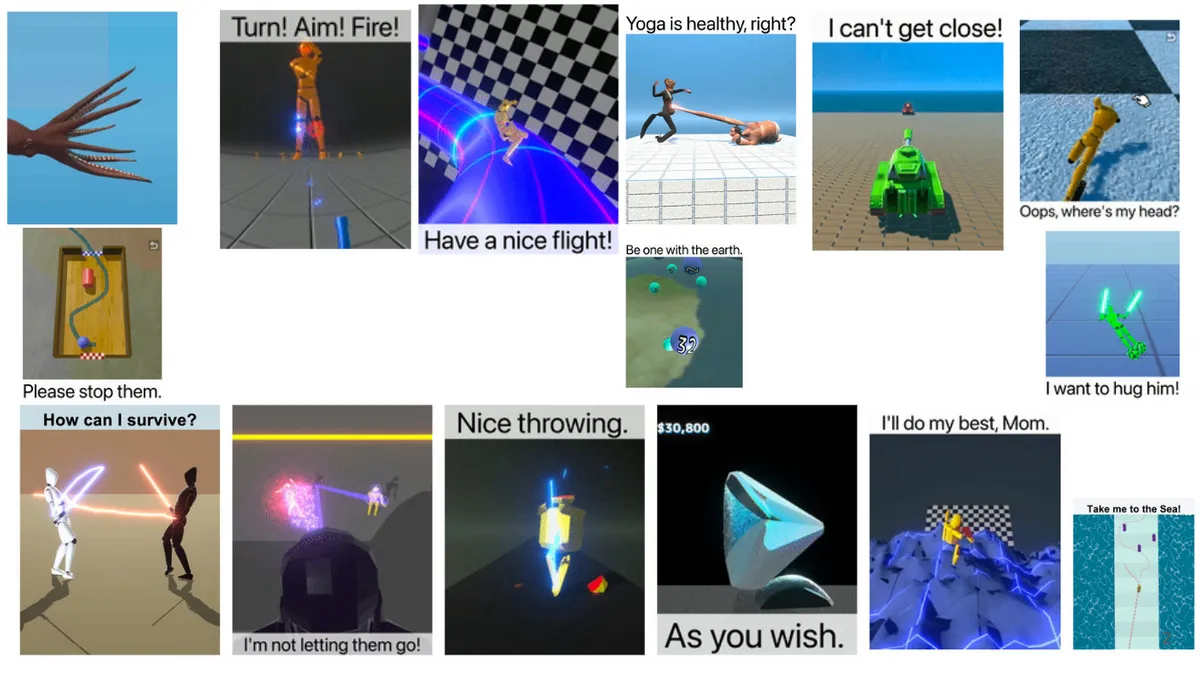 The products I made
These are the products I've planned and built myself, from around 2022 to now. Two of them made a profit.
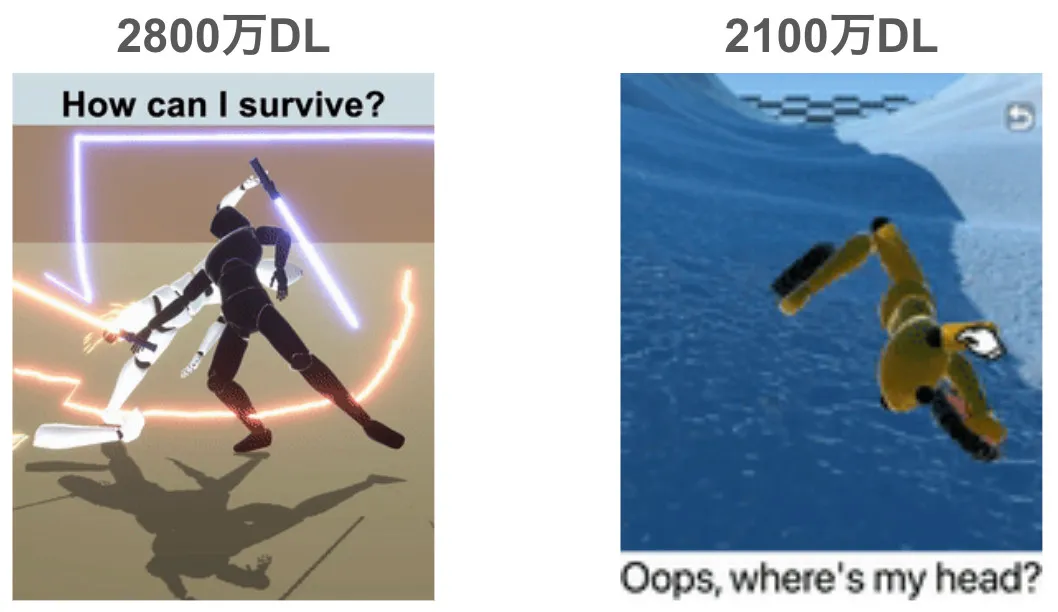 Profitable products
Those are the two, with 28 million and 21 million downloads respectively. There's also one product that came close but never turned a profit.
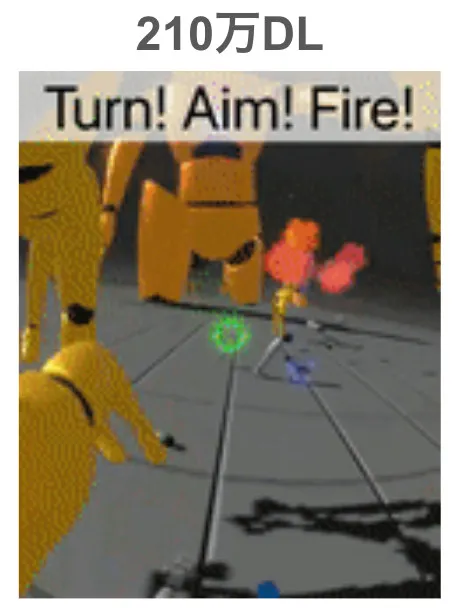 Titan Shoot, which lost money
That one had 2.1 million downloads, only about a tenth of the ones that succeeded.
All together, that's about 50 million downloads. Our company's hyper-casual products have passed one billion downloads in total, so my contribution comes to about one twentieth.
With that track record, I'm going to write about an engineer's work in the hyper-casual business, the skills it calls for, and what makes it worth doing.
Hyper-casual as a business
Before getting to the main topic, let me briefly explain what hyper-casual is. Without that, I don't think the rest will make sense. If I'd described this business to myself five years ago, I wouldn't have understood it at all.
First, hyper-casual, by my definition, is "smartphone apps for killing time, for all of humanity." Some people add "games" and say "hyper-casual games," but I think leaving that off describes the reality better. You could call them a kind of mini-game, but the scope is so small that even "mini-game" feels generous; I don't even make a title screen, for example. A Switch game and a hyper-casual app are about as different as a two-hour film and a TikTok; it feels wrong to call them by the same name.
Because the scope is that small, development is cheap, and the revenue per customer is inevitably low too. It's basically under 50 yen per customer, so we make up for it with volume.
In this genre, I'd only call something a big hit once it passes 100 million downloads; it takes 30 million to count as a hit, and 10 million is a disappointment. So please think of my two profitable products as "successes it would be a stretch to call hits."
How it makes money
A business makes a profit when it buys cheap and sells high. Hyper-casual is the same.
What's unusual, though, is that the "purchase price" is the ad spend, not the development cost, and the "selling price" is ad revenue. In normal game development, development staff costs make up most of the "purchase price," but in hyper-casual the scope is so small that development cost isn't much of an issue. A prototype takes as little as a quarter of a person-month (one person, one week), and even fully built up it's at most about three people for two months (six person-months). Since most products never get past the prototype stage, the majority cost only a quarter to half a person-month to develop. This is probably the lowest development cost humanity can hope for. Unless AI starts making them, it won't get any lower.
Development is that cheap, but in exchange we spend on advertising. We run ads for our products in all sorts of places, people install them through those ads, we show other companies' ads in our apps, and if that ad revenue exceeds what we spent on ads, the difference is profit.
For example, if each install costs 50 yen in ads on average and generates 55 yen in ad revenue on average, that's a 5 yen profit. That's like buying at 50 yen and selling at 55 yen. And if 10 million people install it, that works out to a profit of 50 million yen. Spend 500 million yen on ads to bring in 550 million yen in sales: quite a thrilling business.
Keep this structure in mind and the rest will be easier to follow.
What the engineer does
An engineer's work cycle splits into prototyping and building up.
A prototype takes three days for an unusually fast developer, a week for a fairly fast one, and about two weeks for a slower one like me. Planning, implementation, making the ad video and publishing to the store all happen within that time. Most prototypes are judged hopeless and get no further development, so you're pretty much in a permanent game jam.
Then, if a prototype is lucky enough to do well and looks promising, build-up begins. If one in ten gets that far, you're doing well. And plenty of games still can't be brought into the black even after build-up, and then development stops too.
I've been in the hyper-casual business for about four years, but I only started making my own prototypes about two years ago. Even so, I've made only 15 products; at two weeks each that's 7.5 months, so the numbers don't add up. The rest of the time I was implementing games other people came up with, or building up the ones that did well, and while you're doing that, you get a break from the endless game jam. If not a single product had shown promise, the product list I showed at the start would have about 50 entries. Or, more likely, I'd have gotten fed up with missing again and again and left hyper-casual before that.
Prototypes
A prototype takes two weeks at most. I'm on the slow side, so I feel bad presenting that as the standard, but in practice, if you're going to keep this up for years, I personally think a two-week pace is a sensible baseline. Your body won't hold up otherwise, and if you only make things you can make in a week, you tend to make the same kind of thing over and over, and then the hits stop coming. That said, at first you should aim to be able to make one in a week. I think the right approach is to drop to two weeks once you can do it in one, and to make one in a week now and then to get your sense of speed back.
As for team size, I mostly come up with the idea and implement it on my own. Of course, sometimes the work is split between two people (design and implementation), and sometimes among three (design, art and implementation). Everyone jots rough ideas down in a shared notebook, so another option is to take inspiration from there. You should adapt how you work to what you're good at, and changing it depending on your mood is fine too. Chance encounters matter as well, like "a game designer I happened to talk to came up with an idea that clicked."
In fact, the product Swing Blade (Android, iOS) was made by three of us: me, a game designer and an artist. I wrote the code, the designer built the levels (stages), and the artist handled the models, lighting and materials.
Schedule
Two weeks isn't a company rule or anything; it's just something I impose on myself. But if I break it, there's no limit to how much I'll slack off, so unless something serious comes up I stick to it, and when I did go over, I tried to make the next product in one week.
Two weeks is ten working days, roughly split up as follows.
- Planning: almost zero days
- Usually, while I'm making one product, I already have a picture of "this is the next one," so I never have to stop and think.
- If I haven't decided what to make, I can't stop thinking about it even over the weekend, so it's usually settled by Monday.
- Core gameplay and technical development: 6-7 days
- As I'll describe later, I put some technical challenge into every one, so this eats up time.
- If I deliberately make something with no technical difficulty, or get the idea from a game designer, this gets shorter.
- But if I finish early, I just slack off by that much, so it doesn't really get shorter.
- Testing how far the gameplay can stretch, and preparing data: 1-2 days
- To see what kinds of gameplay the mechanics I implemented can support, I make about 8-10 levels.
- "Toy"-like games tend to have fewer levels.
- Store release: usually Thursday of the second week
- If I submit on Friday, sometimes review still hasn't passed by late Friday night, so Thursday is the default.
- At our company everyone has permission to publish apps to the store, so I release without asking anyone.
- Ad video: Friday evening of the second week
- As I'll describe later, I don't put much into this, so an hour or two at most is enough.
I spend quite a lot of time on technology and on testing the gameplay. If the goal were just to release something, that could be much shorter, but I don't do that. I'm not the type who competes on ideas, and if I cut this, I'd only end up making the same kinds of things.
By the way, I couldn't make one in two weeks from the start either. At first I didn't know how much I could leave out, and it sometimes took more than a month. Gradually you learn what you don't need to do, and when the people around you are fast, you feel the pressure and speed up.
What to leave out
Normally, there's no way to make a game in two weeks. For a game jam, some roughness can't be helped, but this is a product. If you don't release something you believe has value, something you think is fun, there's little point, and it's disrespectful.
So the scope gets cut drastically. For example, the following work is basically never done at the prototype stage.
- Title screen
- Settings screen
- Localization
- Ideally there is no text at all. At most "Start" and "Get".
- Sound
- A large share of people play phone games with the sound off, so it isn't worth the effort.
- But sometimes I add it when I'm in the mood, because it's fun.
- New UI such as icons
- I reuse them from past titles, or make do without any.
- New 3D models
- I take them from the Asset Store, reuse them from past titles, or generate them in code.
- In other words, the basic rule is that it has to work without anything like "an original character design."
- Features to keep people playing for a long time
- No in-game currency to collect and spend on items.
- No need to prepare lots of levels either (for me, it's often "however many I can make in half a day").
To put it bluntly, nothing that doesn't appear in the video needs to be implemented at all.
However, even at the prototype stage you can measure how much people played, and that information matters later too, so if you make something that isn't really playable, you're only hurting yourself. And above all, I won't let myself release something unplayable or obviously boring. I like almost all of my products, including the prototypes that failed; they're still installed on my phone, and I play them now and then.
Ad videos
You make a video that shows off the appeal of the app you made, run it as an ad in various places, and judge whether the prototype is promising by how many installs it gets. The number of installs is the most important metric, so if that were all you cared about, the video would be everything.
Even so, the shared understanding here is that making an elaborate video isn't a good idea. The rough consensus is "record gameplay, cut it, splice it together, and do nothing more."
That's because if you go further, the appeal comes from the editing, not from the app itself, and you can no longer measure how strong the app is. Also, spending time on it drives up the cost of each prototype, so you get fewer shots on goal. Minimal effort is fine. I usually spend about an hour on it on the last day, Friday evening, and hand it off to the marketing team.
If the app is appealing, simply recording it and running the footage as is gets good results. In fact, for Mannequin Downhill, one of the two profitable products above, the first video we ran wasn't even edited. I recorded 20 seconds of gameplay and just ran it. For Draw Saber I got a little greedier and spliced together about ten 2-3 second clips, which took slightly more effort, but I still didn't touch the playback speed. I just spliced them together. Later on, the ad video pros will use their editing skills to make ads that land better, so you can think of that as room left to grow.
By the way, most people use AfterEffects for this, but I figured something free would do and use Shotcut. It's more than enough for cutting and splicing.
How a prototype is judged
Making prototypes and throwing them away, over and over: that's our daily life, but I haven't yet explained how we decide whether a prototype is "good" or "bad."
I touched on it a little in the section on ad videos, but in the end, "an app that gets installed a lot is a good app."
You make an ad video and spend a small amount to run the ad somewhere. Say you spend 10,000 yen over a weekend. If 100 people install it by Monday as a result, you know that each install costs 100 yen in ads. If 200 people installed it, that's 50 yen each. In other words, the lower the ad cost per person, the better, and we use how low it is to measure how promising the app is. This ad cost per person is called CPI (cost per install).
Of course, how much people actually play the app is a separate question. With a game people get bored of instantly, there's no room even to show other companies' ads, and however low the CPI, it can't be brought into the black. But at this stage almost nothing has been built up, so there's no telling how long the app could potentially keep people playing. So the cutoff is a fairly strict line, like "if CPI is under 60 yen, we can probably do something with it later."
If you set it too loosely, you get things like "we kept developing at a CPI of 100 yen, but it plateaued at a level of polish that only earns back 60 yen," and since continued development costs money, the damage is bigger. I think a stricter bar at this stage is probably better.
By the way, average play time, average number of launches, average levels (stages) cleared, and the rate of clearing the final level can all be measured even at the prototype stage (with adjust plus custom events). Whether to factor them into the pass/fail decision is up to each organization, but knowing whether your gameplay is fun or boring matters to a game developer. When prototype after prototype fails, you tend to think only about passing, but passing means nothing if the game doesn't turn a profit, so what matters is whether, once it passes, there's room to make it fun enough to be profitable. My games often have a play time of about 12-13 minutes, and occasionally 20-23 minutes. Titan Shoot passed on CPI, but its play time was only about 6 minutes, and I had a very bad feeling about it. The longer the play time at this stage, the easier the fight later on will probably be.
Building it up
Once a prototype gets lots of installs at a low CPI and it looks like "this one has potential," build-up starts.
At this stage the app is rough and has little content, and in most cases it can't yet earn more in ad revenue than was spent on ads. For that matter, it probably isn't even set up to show ads (I don't even put an ad SDK in at this stage).
So first, we get ads showing and measure how much ad revenue comes in. The main source of ad revenue in a hyper-casual app is the so-called "interstitial ad": the game pauses between levels (stages) and a full-screen ad plays. The banner always shown at the bottom of the screen doesn't pay much, and rewarded ads of the "watch an ad to get an item" kind require you to implement the items to give out in the first place, so interstitials inevitably become the main source at first.
If you're paying 50 yen in ad spend per person (= a CPI of 50 yen), you have to earn 50 yen in ad revenue per person or there's no business. And to increase ad revenue, you need to increase either the revenue per ad or the number of ads shown. The former is out of our hands, so the latter is the main lever.
And the longer the play time, the more chances there are to show ads, so in the end we arrive at the extremely clear conclusion that you just have to make the game more fun and lengthen play time.
Make a fun game and you make a profit: a very simple and happy conclusion. We want to make fun games anyway, so you could say nothing could make us happier.
Ad revenue and downloads
So far, to keep things simple, I've talked as if CPI were fixed at some amount up front, and you make a profit once ad revenue exceeds it (the video above doesn't go beyond that either). But in fact it isn't that simple.
First, CPI, the ad cost per person, isn't fixed. If you pay more, you can run ads in places where people are more likely to come. For example, a TV ad is probably more effective than one on a train, right? But it probably costs more too, right? It's roughly like that.
So if improving the game raises ad revenue, you can afford to pay that much more for ads. The more you pay for ads, the more customers come, so the margin shrinks but the total profit can grow.
For example, if you pay 50 yen in ad costs and earn 60 yen in ad revenue, that's 10 yen profit per person. But if that brings in only 1 million customers, the profit stays at 10 million yen. Now, if paying 55 yen in ad costs increases the customers to 5 million, the margin drops to 5 yen, but the profit grows to 25 million yen. When ad revenue increases, you can pay more for ads while keeping the same margin, and that lets you increase the number of customers.
That's what make a fun game and you make a profit means, and it also makes build-up a life-or-death stage.
Unless you recoup the development cost, it isn't profitable overall, so even if ad revenue exceeds CPI, it's no good unless enough people play it.
For example, if the development cost is 4 million yen, then at 4 yen profit per person you need 1 million downloads. In reality you also have to cover the development cost of all the prototypes that didn't hit, so the profit needed easily exceeds ten times that. That's what I meant earlier by "10 million downloads is a disappointment."
"Update hell"
So what does this continued development look like?
In my case, updating the app two or three times a week is normal. Five or six times a week isn't unusual either. That's because fumbling at this stage can be fatal. In terms of working hours, it can be tougher than prototyping.
Why the rush? Because the moment you push an update, other companies can tell that this is a promising app. Nobody updates a hopeless app. If someone makes a more polished version of the same idea, we lose.
Also, quite simply, dawdling at this stage costs too much. At the prototype stage, staff costs are small, but once you're updating to get into the black, the whole organization may put people on it. Then staff costs over the same period multiply, so you have no choice but to hurry. And even after getting this far, there's a decent chance it can't be made profitable in the end, and you may end up thinking, "if it was going to fail anyway, we should have given up much sooner."
On top of that, if people start saying "You're having a hard time getting this into the black, aren't you? Wouldn't it be better to drop it and make another, more promising prototype?", all the hard work of getting a good CPI goes to waste. You don't want to miss your chance to put your game out into the world, do you?
For these reasons, the period of updating like mad to get into the black is often mentally harder than the period of making prototypes and throwing them away. It depends on the person, though.
What the updates change
So what do the updates do?
The first thing is to smooth out the prototype's rough edges. A prototype is made in two weeks, after all, so it's almost always rough even in the basics.
The control scheme is fundamentally wrong, the camera work is bad, the controls feel bad, the difficulty is off, the CPU load is needlessly high, the app size is needlessly large, it slows down in odd places, it crashes, and so on: there are lots of flaws you could call "rough edges." Fixing these first is important.
People who watched the ad video installed the app with certain expectations. When play time doesn't increase, it's basically because those expectations are let down. For example, if the controls differ from what the customer imagined from the video, that's a reason to stop playing.
Once these basic problems are mostly solved, the focus shifts to broadening the gameplay and adding content. If there are only a few ways to play, people get bored fast, so broadening that is the first thing to think about. What to add to broaden the gameplay effectively is an important question.
For example, Mannequin Downhill is basically "a racing game of sorts where you head down a road," so more courses broaden the gameplay. But adding any number of similar courses doesn't. So first I implemented a fair number of elements that can be placed on a course, like "how sharp the curves are," "how bumpy it is," "obstacles" and "cliffs," and tested and experimented with how they broaden the gameplay and which combinations are fun.
Also, in racing games, letting players choose their character is a standard way to broaden the game. The gameplay multiplies: "number of courses × number of vehicles." The usual distinctions are things like slow acceleration but high top speed, quick acceleration but low top speed, easy cornering and so on, but in Mannequin Downhill I made several obviously different vehicles: "one with wings that glides on lift," "a motorbike," "just a ball, not even human-shaped." There's no competition and not even a timer, so handling differently mattered more than having an advantage.
Adding in-game "money" to buy items or upgrade stats is also a strong option, but it tends to spoil the game's simplicity and clutter the screen, so my impression is that, done badly, it often does more harm than good. If the gameplay isn't suited to it in the first place, it ends up as little more than a cosmetic change, and you can't expect much from it. It's a lot of effort for little payoff, and I find adding elements unrelated to the core gameplay tedious and don't like it, so I often skip that kind of change. But if the gameplay was designed from the start so that such upgrades mean something, it has the potential to be a very big improvement. I tried some of this in Titan Shoot, but the game couldn't be brought into the black, so it was left half-finished.
A/B tests
Whether improvements like those above actually increase play time is surprisingly hard to know. If anything, you could say they make it worse more often than not.
"It must be more fun this way" is basically the developer's assumption, and whether customers agree with it can't be known until you try. So I run A/B tests on almost every change.
First, Android lets you distribute two versions at the same time, so instead of rolling the new version out to 100% right away, we distribute the old and new versions side by side. Then, by collecting data and applying statistical methods, you can infer which version performs better (I have written a blog post about A/B testing before).
Also, within a single version, I sometimes prepare several variants of, say, level order and content, assign them to customers at random, and judge which performs best.
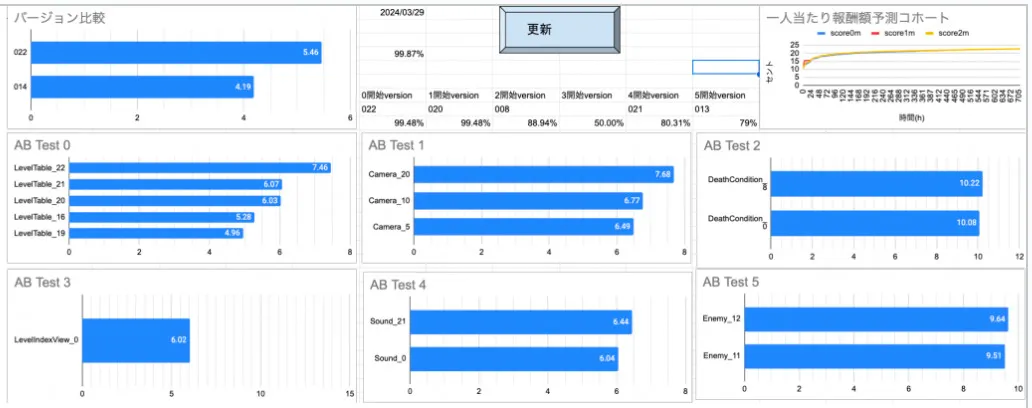 An example of A/B tests
This is a screenshot of a tool I made to check on A/B tests easily. "Tool" is a big word for it: it's a script (GAS) attached to a spreadsheet, and it doesn't do much. It graphs the results of A/B tests comparing two versions, level orders, camera work, sound effect settings and so on. I made it for people who find working in BigQuery a chore, but I end up using it myself too.
Does it turn a profit?
We keep updating like this to get the game into the black. Draw Saber was updated about 20 times, Mannequin Downhill about 60.
Some of those updates came after the game was already profitable, to widen the margin, so it doesn't necessarily take that many updates to get into the black. But getting into the black is usually hard, because the first goal, above all, is "reaching a level of ad revenue that brings in a meaningful number of people," and that's quite a long way off.
If you keep CPI low, that is, only run ads in cheap places, making it profitable per customer is easy in itself. Even with fairly low ad revenue, it's profitable per customer. But as I mentioned, the lower the CPI, the fewer the customers. If only 100 people install it a day, the profit is at most around 500 yen, so even with a development cost of just a few million yen, there's no way to recoup it.
If you want to recoup everything, including the development cost of products that never got past the prototype stage because their CPI was too high, you need tens of thousands of installs a day, so even just "making it profitable" is a high bar.
With prototypes, you can tell yourself "it won't hit anyway" and happily make whatever you like, but once build-up starts, that easygoing feeling disappears.
In fact, Titan Shoot got 40 updates but never made it into the black. It's fair to call it a total flop.
But once you're in the black and the game keeps earning more than your own salary costs, all that pressure disappears. From there, you can aim for your ideal game and do what you wanted to do, until you get bored. You scored a hit, so you've earned that much, right?
However, nothing can go into the app without passing the A/B testing process above (that's just a rule I impose on myself), and since the original scope is small, there's a limit to how far you can polish or expand it. Moreover, the further the improvements go, the harder it is to raise ad revenue. Going from 10 levels to 20 has a big effect, since many people clear 10 levels, but going from 100 to 110 only benefits people who cleared all 100. Naturally, the overall numbers get harder to move. Eventually the day comes when changes can no longer pass the A/B tests and can't be justified on cost-effectiveness either. Or you might simply get bored.
Then it's back to making prototypes. But that's a happy ending.
Skills an engineer needs
So far I've described what an engineer's work actually involves. Some of you may be thinking, "Wait, is that really an engineer's job?"
Roughly sorting the skills mentioned so far gives the following.
- Implementation
- The ability to implement a spec and bring it to life
- The ability to make apps with size and performance in mind
- The ability to use advanced algorithms to achieve what others can't, or to reach a high level of quality
- Ideas
- The ability to come up with fun concepts
- The ability to grasp the conditions for being accepted in the hyper-casual market
- Visual design
- The ability to choose colors and screen layouts that get the point across in a few seconds
- The ability to pick out the important information and bring it out on screen through art and lighting
- Video making
- The ability to make videos that catch the eye within seconds and convey the fun of the core play directly
- Improving the gameplay
- The ability to infer what customers find fun and what frustrates them, and to act on it
- Game design knowledge and skills for broadening the gameplay
- The ability to turn gameplay into concrete data such as levels (level design)
- Data analysis
- The ability to work out how to use behavioral data from thousands to hundreds of thousands of people to test your hypotheses
- The ability to use statistical knowledge to make more reliable decisions with less data
- The ability to process data with SQL and other tools
- Endurance
- The ability to keep calmly making things no matter how many prototypes miss
- The tenacity to keep improving a game through dozens of iterations
Only the first is what the word "engineer" usually brings to mind. Data analysis may also fall within an engineer's remit, but I don't think it's normally expected to be the same engineer who actually builds the game in Unity.
But I've ended up doing all of this myself, and doing it yourself definitely has advantages. I'd never claim to be highly skilled at all of these, and some I'm clearly bad at, but even so, doing everything alone avoids extra staff costs, has no communication overhead, and lets me make what I want to make.
And rather than narrowly defining yourself as "an engineer," you can broaden your range. You may discover aptitudes you never imagined you had. The key point is that only an engineer can do all of this alone. For a game designer or artist who can't write code at all, doing everything alone, including implementation, is extremely hard; this is an engineer's privilege. The days when programmers made games are back.
But however you look at it, expecting all of these abilities from one person is too much. So it usually makes sense to avoid what you're bad at or leave it to others.
For example, if you don't want to compete on technical skill, you can steer clear of difficult technology. If you build in Unity relying mainly on physics, you need to write a lot less code. If you don't want to do data analysis, you can skip complex A/B tests, only compare versions, and hand the statistical tests off to someone else or have someone build a tool for them. For art, relying on the Asset Store or asking an artist is, if anything, the norm. In my case, I have very little confidence in my ideas, so I try to compete in ways that don't depend on ideas. I'll go into this in detail later.
You can also split the work by stage. Some people are good at making prototypes but aren't confident about, or even interested in, improving them afterwards. In that case it's common to hand the prototype off to someone else once it's done and go back to prototyping. In fact, until a little over two years ago, my main job was taking other people's prototypes and getting them into the black.
Everyone is different, so you should look for a way to contribute that suits you. Otherwise I don't think it'll last, and results will be hard to come by. Frankly, even someone who says "I'm only interested in technology, I don't care what the game is about" can surely be put to good use if their technical skills are outstanding. If you can make something that demands extremely advanced technology, something other companies can't copy, and it hits, you'll have a big advantage. If you're sure other companies can't make it, there's no need to fear copycats.
That said, let me also point out a few problems with dividing up the work.
For example, if prototyping and improvement are separated, the person doing prototypes does nothing but prototypes, and having to come up with ideas that often can wear them out. Also, if design and implementation are separated, the person implementing may not feel like it's their game, and there's a risk that they can't quite get into it and quality drops, or that they come to dislike the work. If you ask someone other than the developer to make the ad video, there's a risk that it takes effort to get them to understand the core gameplay, or that it doesn't come across well. I'm the type who takes those risks seriously, so I end up thinking "even if I'm not great at it, I'll just do it myself," but if you can split the work while keeping those drawbacks in check, and use specialization to raise efficiency and quality, that's better. In fact, I don't seem to be very good at ad videos, and when someone else made one, theirs fairly often performed better.
What makes it worth doing for an engineer
By now this has turned into a story of how an engineer's work in hyper-casual doesn't look much like engineering.
So, am I an engineer?
Honestly, I'm no longer sure. The moment I started deciding what to make myself, I may have stepped outside an engineer's territory. I believe "organizations exist to make use of each person's specialty," so by nature I lean toward dividing up the work. In a book I wrote in the past I clearly wrote things like "the game designer works out the spec and the artist draws," and my view basically hasn't changed. Yet I've ended up making things alone, and the situation feels very strange to me.
Even so, I also feel that I'm an engineer after all. Let me close with that story.
Technology-driven hyper-casual
My prototypes basically start from technology. "This time I want to try this technique." "Then here's the gameplay I can build with it." That's how it goes. "This theme looks like it would sell" or "this kind of game looks fun" comes second; first I decide "this time I'll use this technology." And even though I only have two weeks, I happily spend half of them on the technology.
Worse, and this is the scary part, even if that technology already exists out there as a ready-made package, I build it myself. I'm afraid of being told "there's already a library for that," so I don't even look it up. I just start building it. There are various reasons, but ultimately it's simply because I want to. I do make an effort to get the most out of what I built and turn it into results, and at least for Draw Saber and Mannequin Downhill that probably paid off, but you can't call it a sound attitude. In other words, in the end I'm driven by an engineer's ego: "I want to implement it myself." In that sense, I think I am an engineer.
So let me look back a bit at what I've made so far.
Unreal Sumou to Draw Saber
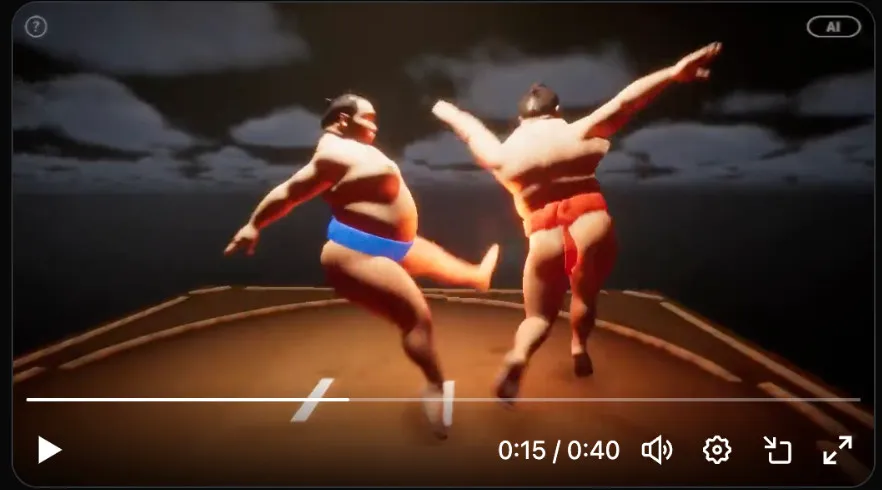 Unreal Sumou
This is a sumo game I made at the end of 2021 for the company's "development event outside regular duties" (this article has the details). The person who pitched it, トモぞヴP, seemed to have a normal sumo fighting game in mind, but I completely ignored that, used no ready-made animations (AnimationClip), and started making a creepy sumo-like thing driven entirely by physics.
It couldn't even stand; it hung from an invisible hook at the hips. Technically it was as crude as it gets, but perhaps thanks to the creepiness that gave off, it went a little viral, and I think I got rather full of myself.
This became the seed of Draw Saber.
When I thought, "Might as well make it hyper-casual," sumo was out of the question as a theme. You don't sell sumo to the whole world. And given the nature of a smartphone, a control scheme with punch and kick buttons doesn't fit. I remembered ParkMaster, which I'd worked on during its build-up. Drawing a line to attack is intuitive, but switching between punches and kicks would be a pain. So I gave them weapons. If you're holding a weapon, it's natural to move the weapon.
Luckily, it sold.
But the hips still hung from a hook, and I hadn't achieved my goal of standing up through physics. That frustration led to the next game.
Mannequin Downhill, and after
A little before that, a prototype someone else had made did well, and I took a shot at building it up.
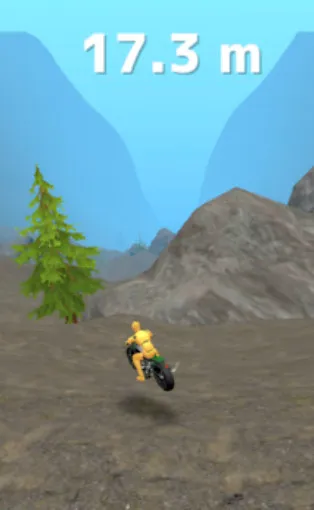 Ragdoll Master
A doll on a motorbike rides down a slope, and when it eventually crashes, the doll is thrown off the bike and goes flying, and where it lands, something like "XXX meters flown" appears.
On the next run you can upgrade the engine and so on to extend the distance; that's how it worked.
It was beyond me and I couldn't get it into the black, but I did notice something: "Does this even need to be a motorbike?"
After all sorts of trial and error, the ad videos showed only the scenes after the doll was thrown, with almost no time spent riding the bike. If what people liked was seeing a human body get thrown, you could guess the bike wasn't needed. So wouldn't it be funnier to run down the slope from the start, trip over your own legs and fall?
But back then I couldn't even imagine how to make it run down a slope on two legs, so the idea sat on the shelf. Even by the time of Draw Saber, I couldn't even make it stand. Making it run was completely out of reach.
Normally you'd make a running animation in advance and play it, but I was firmly convinced that it wouldn't be fun unless it was done with physics, and I'd sworn not to make it until I could do it with physics.
Then, while making a prototype after Draw Saber came out, I suddenly remembered this. "Maybe I can make it run now."
I took on the challenge and managed to make it stand without hanging it by the hips, but there were only three days left of my self-imposed two weeks. So I reluctantly compromised: let's put wheels on it.
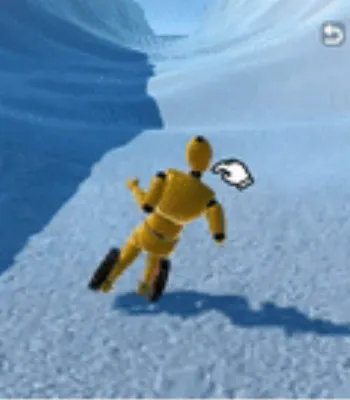 Mannequin Downhill
That was Mannequin Downhill. And it sold.
I kept developing this and, a few months ago, made a prototype that finally achieved the two-legged running I couldn't manage back then. That one also made it to the build-up stage.
Choosing to be technology-driven
Those are the successes, but almost all of the products that went nowhere were technology-driven too. I made a gem-cutting app out of pure ego ("I want to write my own mesh cutting!"), and tried another out of a reckless wish ("I want to do a fisheye lens! If it hits, I'll make it VR!"); in every case I can think of, the technology came first. Titan Shoot, the fisheye lens one, also got as far as build-up. It flopped there, but it shows that even when you build technology-first, you can get a low CPI.
Building technology-first naturally produces products that are hard to copy. It's different if a library that does the same thing at high quality is already available, but otherwise making a similar product is hard, and even if a library with equal or better features is out there, it often seems hard to use well, especially in physics. So it's at least somewhat harder to copy.
Another advantage is that you can keep building without worrying when ideas don't come. Figuring out which theme and which game mechanics would sell is hard. Unless you're someone who takes in lots of things every day and thinks about what's fun around the clock, you rarely make a hit. But with a technology-driven approach, it's easy. First you pick a technology that would sell if you could pull it off. For example, if the idea is "a person running down a slope on two legs and falling over would be hilarious," then all you need is running on two legs. Once you've achieved "running on two legs and falling," the core gameplay is already there. Show that in the video and it should be fun. That's the hypothesis, after all. Whether to put the camera to the side, overhead or behind follows backwards from the core gameplay ("watching it run and fall is funny") and from the controls a smartphone allows, so you don't agonize much.
The same goes for the fisheye lens. If a fisheye lens shines anywhere, it's when you move your view. Especially when you look up or down, the screen warps dramatically and gives a feel unlike anything else. Also, a fisheye lens fits a wider area than usual on one screen, so it's easy to see that it would suit gameplay where a wide field of view matters. From there, "you stay in place, turn your view and shoot giant titans closing in from 360 degrees" may or may not be the most fun option, but as a reasonable answer it follows naturally, I think. No idea required.
On top of that, with a technology-driven approach, your skills advance with every prototype, so you don't mind much when one doesn't pass; there's that psychological advantage too. You get the satisfaction of "this time I learned to do this," so a miss doesn't bother you. Some may think not being desperate for a hit is a problem, but being desperate won't get you a hit. I believe it's more important to stay relaxed, keep up your pace, and avoid making too many similar things. With a technology-driven approach, you don't keep making the same things, and if you're having fun, you keep up your pace, so isn't that good enough?
The day will come when I stop getting results too, and then I'll just retire from hyper-casual and go back to being "an engineer." Nobody can stay in the hit-or-miss business for very long, and the fact that I get to do this kind of work now is a miracle in itself, or a bit of a joke. I wouldn't be surprised to wake up and find it was all a dream.
Closing
In this article I wrote about how the hyper-casual business works, and, within it, the work engineers do, the skills it takes, and what makes it worth doing.
For twenty-odd years I had little to do with game content, and believed in doing my job as a technical specialist, but you never know what life will bring.
I've somehow earned the title of "the 50-million-download man," and I spend my days thinking, "When will this baffling party end? Is it all going to turn out to be a dream?" When you join a new business like hyper-casual, you can get swept up in baffling parties like this and have a great time, so I recommend it. It's tough, though.
As I see it, hyper-casual is "the outer extreme of game development." I don't think a crazier way of developing games is possible as long as humans are the ones making them. Trade Off says that in the battle between "fidelity" and "convenience," convenience has the edge, and the market for things like this will probably never go away. It's already a cutthroat red ocean, but the world's smartphone population is still growing, and as the economy's center of gravity gradually shifts to emerging countries, new opportunities will appear. If anything, if the red ocean makes it harder to win with copycat products, it becomes the perfect environment for the fun challenge of "winning by slamming something other companies won't make onto the market," which makes it all the more enjoyable, I think. If you see yourself as an engineer and hone your skills every day, isn't that exactly the kind of fight you're looking for?
So I think choosing hyper-casual as a home for an engineer isn't so bad. ...Though, for all I'm saying, I might not be able to stand it three months from now.
Incidentally, this was originally a talk I submitted to CEDEC. It was rejected, so to give it a proper send-off I recorded it at an internal study session, and for those who find watching videos a chore, I also wrote it up as text.